For executors dealing with an estate
The estate’s accounts, kept as you go
Everything the person owned and owed, every payment in and out, what each beneficiary receives, and the dates you can’t miss. At the end, estate accounts that balance to the penny, ready to share.
- Your records stay on your device. No account, nothing uploaded
- Ready for the April 2027 pension changes
- Free for up to 10 items. £39 per estate for everything
How it works
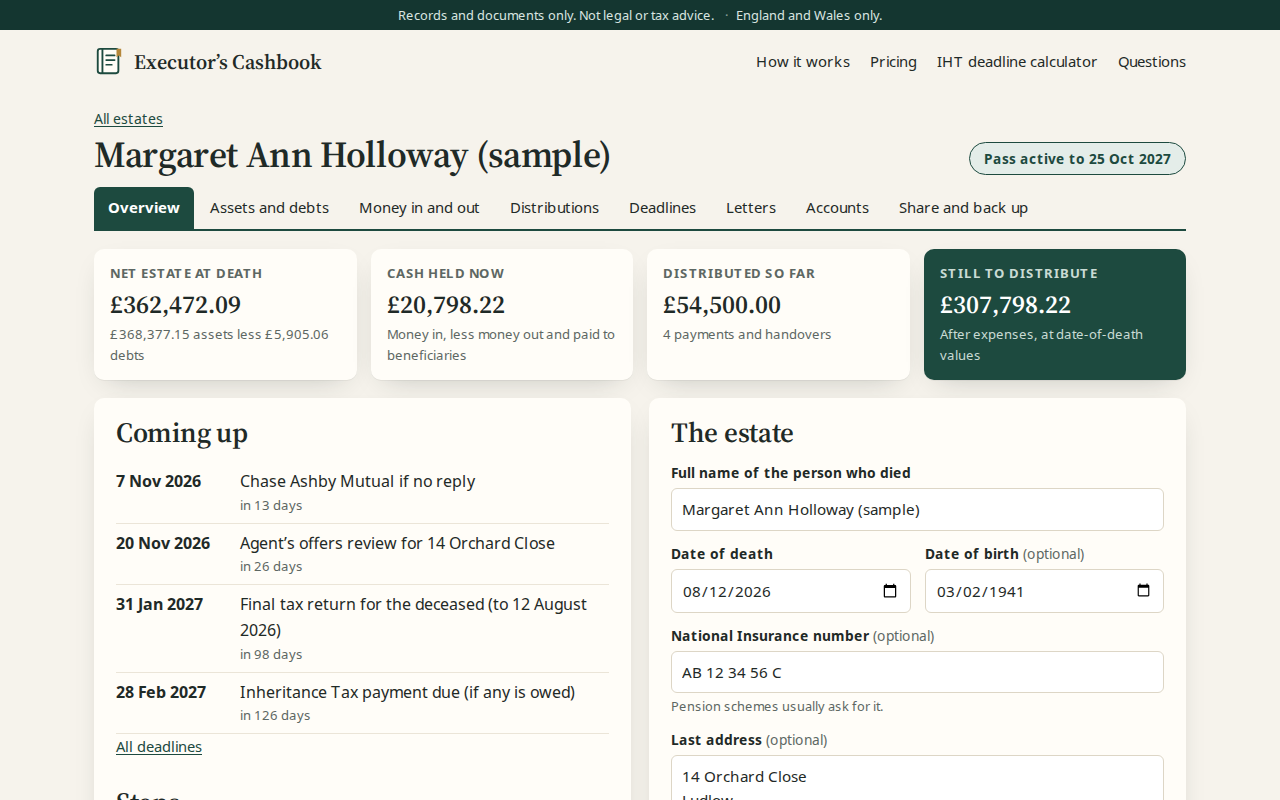
- List the estate. Bank accounts, the house, investments, pensions, the car, and the debts and funeral bill, each at its value on the date of death.
- Write to the schemes. A ready-made letter asks each pension scheme or bank what’s held and what’s payable. Mark it sent and you’ll be reminded to chase after four weeks.
- Record money in and out. Link each payment to the account it closed or the debt it paid. Gains, losses and expenses fall into place.
- Share the accounts. Record what each beneficiary receives, then download estate accounts in the usual capital, income and distribution layout.
Deadline board
The Inheritance Tax payment date (the end of the sixth month after the death), the IHT400 date, chase dates for every letter, and your own reminders, soonest first.
Accounts that balance
Every figure ties back: the balance left to distribute always matches the cash held plus anything not yet sold, less debts not yet paid. Beneficiaries can follow it line by line.
Private by design
There’s no server holding estate data. Back up to a file, or send an encrypted copy to a co-executor with a passphrase only they know.
Pensions from April 2027
Most unused pension funds will count towards the estate for Inheritance Tax. Keep each scheme on the register, write to it, and track the reply.
What the beneficiaries see
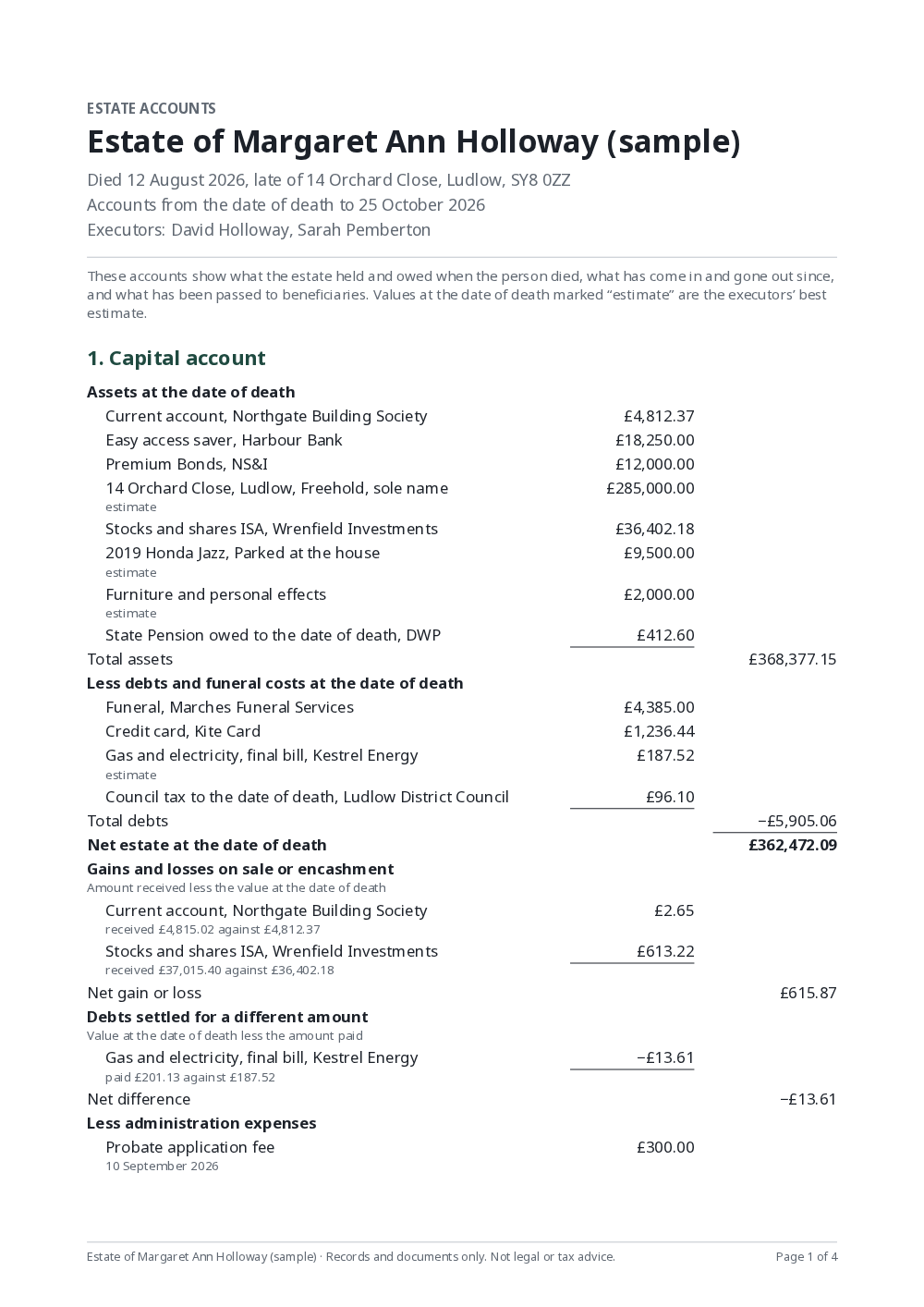
A clear set of estate accounts in the usual layout:
- Capital account: assets and debts at death, gains and losses on sale, expenses
- Income account: interest, dividends and rent after the death
- Distribution account: what each beneficiary received
- A reconciliation to the cash held, and every payment in a schedule
- Space for each beneficiary to sign their approval
Records and documents only. Not legal or tax advice.
Pricing
Free
£0
- Up to 10 assets and debts
- Ledger, distributions and deadline board
- Pension and bank letters
- Accounts on screen
- Backups and encrypted sharing
Estate pass
£39 per estate, 12 months
- Everything in Free
- Unlimited assets, debts and records
- Estate accounts PDF, as often as you need
- Works in up to three browsers, for co-executors
- 12 more months for £19 if it takes longer
One payment by card through Stripe. Not a subscription. 14-day refunds.
Questions
Is this legal or tax advice?
No. Executor’s Cashbook is a record-keeping tool. It holds the figures you put in and lays them out as estate accounts, letters and a list of dates. It doesn’t tell you what to do, prepare the probate application or Inheritance Tax forms, or work out any tax. If you’re unsure about something, speak to a solicitor or a probate practitioner.
Where are my records kept?
In your browser, on your device. Nothing about the estate is sent to us: there’s no account to make and no server holding your data. Our licence server only sees a licence key and a random ID for your browser, and our page counter sees which pages are visited, never what you type.
What if I lose my laptop or clear my browser?
Then the records in that browser are gone, which is why the app reminds you to download a backup after you make changes. A backup is one small file you can keep anywhere and open again later, on any computer.
Can a co-executor use it too?
Yes. Download an encrypted copy with a passphrase and send it to them; they open it in their own browser. A pass works in up to three browsers, so it travels with the estate. Each of you keeps your own copy, so agree who records what, and swap files when you’ve made changes.
What do beneficiaries get?
A PDF of the estate accounts: a capital account (what was owned and owed at death, gains and losses on sale, and expenses), an income account, a distribution account showing what each person received, a reconciliation to the cash held, a schedule of every payment in and out, and space for signatures.
Does it work for Scotland or Northern Ireland?
Not yet. It’s built around the process in England and Wales. Scotland has a different system (confirmation, and executry terms), and Northern Ireland has its own probate office and rules.
What changes for pensions in April 2027?
For deaths on or after 6 April 2027, most unused pension funds and death benefits count towards the estate’s value for Inheritance Tax, and personal representatives deal with reporting and paying it. The register keeps each scheme’s figures, the letters ask schemes for them, and the deadline board shows when to chase. Read our guide to the April 2027 change.
How much is it?
Free for up to 10 assets and debts, with the on-screen accounts, letters and deadlines. A pass for one estate is £39, paid once, and lasts 12 months; it unlocks unlimited items and the accounts PDF. If the estate takes longer, 12 more months is £19. It isn’t a subscription.
Can I get a refund?
Yes. Email admin@onibaku.co.uk within 14 days of buying and we’ll refund you.
Built for England and Wales. Not for Scotland or Northern Ireland yet.